
News & Perspectives
The Clause That Could Void Your Cyber Insurance Claim, and Why We Don’t Complete Your Application
An insurance application can look like an ordinary questionnaire. It is also a set of representations on which an insurer may rely when deciding whether to offer coverage and on what terms. A broad answer about multifactor authentication, endpoint protection, or backups can become a problem later if the answer describes more protection than the business actually has.
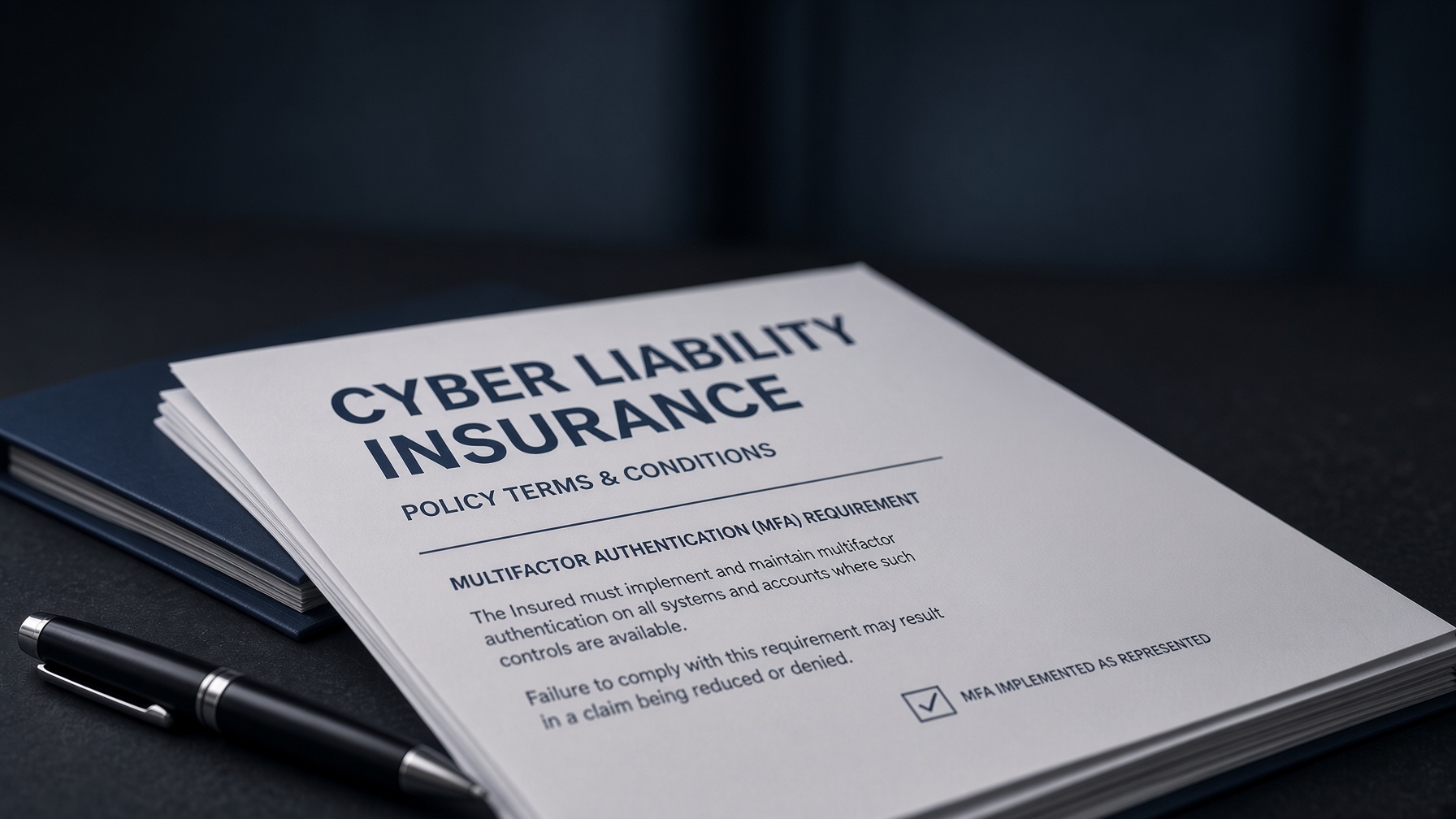
The objective is not simply to get an application accepted. It is to obtain appropriate insurance on an accurate description of your business, with the limitations understood before a loss.
Why the Questions Have Become More Specific
Cyber insurance underwriting has developed considerably from the industry’s early years. Ransomware losses and other cyber incidents have prompted closer scrutiny of applicants’ controls. Insurers may ask about remote access, administrative accounts, cloud email, endpoint monitoring, patching, backups, and incident response. Requirements differ among insurers and policies; a familiar questionnaire should never be assumed to mean familiar terms.
The New York Department of Financial Services documented this shift in its Cyber Insurance Risk Framework, recommending detailed assessment of each applicant’s security program and potential gaps. This is by no means an assurance that every insurer’s requirements or premiums will move in the same direction every year, but it is useful context.
The Problem With “All” and “Every”
Does MFA protect every account? Is endpoint protection installed on all devices? A simple yes or no field can make a complicated environment appear much simpler than it is. When exceptions are known to exist, providing a response that is absolute or all-encompassing could pose problems later.
For example, a business may have MFA on its main sign-in portal while a legacy application uses a different authentication path. An endpoint agent may protect supported workstations and servers but be unavailable for a particular appliance. Service accounts, emergency-access arrangements, and systems outside the managed environment may require separate consideration. An exception can be justified technically and still make an unqualified “yes” inaccurate.
Defining the scope matters. “All managed Windows workstations and servers in the attached inventory, except the two legacy systems listed” describes a different situation from “all devices.” Neither wording makes the exception acceptable to the insurer by itself. The exception must be disclosed, and the insurer must decide whether and how to insure the risk.
A Gap Can Put Coverage at Risk
A material discrepancy between an application and the actual environment may lead to a coverage dispute, denial of a claim, or an attempt to rescind the policy. The result depends on the application, policy language, facts, and applicable law. It is not correct to say that every deployment gap automatically voids coverage.
It is equally unsafe to assume that an inaccurate answer matters only if it caused the eventual breach. In some circumstances, the relevant question is whether the information was material to the underwriting decision. The connection to a particular incident is not the only issue that may arise. A broker or qualified attorney should address the consequences under the actual policy.
Why Sandbox Provides Answers Separately
It is natural (and expected) to ask your Sandbox team for help understanding technical questions. That is part of why you have us. We can investigate the controls we manage, explain what is deployed, identify known exceptions, and provide supporting technical information.
That said, we are outside technical advisors to our clients and not employees, and our service relationship does not by itself authorize us to make legal representations or sign insurance applications on your company’s behalf. Our practice is to provide technical responses separately, rather than completing or signing applicant declarations. The application and its certification remain with your authorized representative, with your broker and counsel involved where appropriate.
This is a boundary around authority and professional responsibility. Sandbox is not acting as your insurance broker or attorney and we do not interpret coverage or give legal advice. Providing technical facts is not the same as deciding how your company should make a contractual representation. Being a contractor does not, by itself, make all assistance with a form unlawful.
If your Sandbox engineer responds in an email or a separate document instead of filling in the insurer’s fields, understand that is not a refusal to help. The response can follow the application’s question numbers, describe the evidence and scope, and identify qualifications. Your authorized representative can then use that information to complete the application accurately.
When the Form’s Phrasing Does Not Lend Itself to an Honest Explanation
A cramped electronic form is not a reason to turn a qualified answer into an unqualified one. If neither available answer accurately describes the environment, pause and ask the broker how to submit the explanation to the insurer. Do not leave required questions unanswered or choose an inaccurate answer simply to advance to the next screen.
We have historically used annotated working copies, notes in margins, and separate explanations to show the technical qualifications clearly. Those are ways to communicate the facts; they do not amend a policy or bind an insurer merely because someone wrote them down.
- Identify the question and its scope. Specify the systems, accounts, locations, and date covered by the answer.
- State what is verified. Give actual counts or clearly identified estimates with their basis. Distinguish deployed controls from planned work and unverified systems.
- Disclose exceptions. Explain exclusions, unsupported technology, and compensating controls without implying that a different control satisfies the insurer’s requirement.
- Resolve the submission format. Ask the broker to obtain the insurer’s direction on attachments, annotations, or a revised application. Keep the qualifications with the answers; an internal email the insurer never receives is not a disclosure to the insurer.
- Obtain written confirmation. Confirm that the insurer has received and considered the qualifications and clarify any corresponding policy terms or endorsements. Receipt alone is not acceptance of an exception or a promise of coverage.
- Retain the complete record. Keep the submitted application, attachments, correspondence, evidence, and issued policy together. Address changes and renewal obligations under the policy’s actual terms.
Review the Coverage Before You Need It
An accepted application is only part of the job. Review the complete policy, schedule and endorsements thoroughly with your insurance broker and counsel. Check that the covered losses, overall limits, sublimits, deductibles or retentions, waiting periods and conditions fit your organization. Work through realistic scenarios: several days without systems, stolen client information, a cloud-provider outage, fraudulent payment instructions, and an incident involving a state-linked attacker. Ask which provisions would respond, what expenses would be your responsibility, and where coverage could be limited or excluded. Resolve material uncertainty before buying or renewing the policy, and retain the insurer’s written clarification or agreed endorsement.
Pay particular attention to exclusions and definitions concerning war, state-backed cyber operations and terrorism or cyberterrorism. They are not interchangeable labels. Depending on the wording, some losses may be excluded, limited, or covered through a specific exception or separate coverage grant. A government’s involvement in an armed conflict does not automatically exclude every cyber incident, and a formal declaration of war may not necessarily be required for a relevant exclusion to apply. Some state-backed cyber exclusions address operations outside an armed conflict. Ask how the proposed policy defines the event, attributes it to a state and connects it to the claimed loss.
This is a reason to examine the contract, not a prediction that a claim will be denied. Lloyd’s has issued specific requirements for state-backed cyber-attack wordings, and the Lloyd’s Market Association publishes different model clauses. Those materials illustrate why the actual wording matters; they do not establish the coverage under your policy. See Lloyd’s state-backed cyber-attack wording requirements and the LMA example war and cyber operation exclusion. Ask your broker and counsel to explain the treatment of each scenario under the policy you are considering.
Acceptance Is Not the Only Measure of Success
Could a candid explanation cause an insurer to decline the application, require additional controls, or offer different terms? Certainly. That can be inconvenient and can require more work with your broker.
Before anyone considers providing a response that is not 100% truthful, they need to ask themselves which is worse: spending the time to find a suitable policy on truthful terms, or paying for coverage that may be disputed after a serious loss because the application did not accurately describe the business’s security controls.
Your Sandbox engineer or Consulting CIO can help establish the technical facts. Your broker and counsel should be consulted to resolve how those facts affect the application and the proposed insurance. A clear record should be retained of what was represented and accepted.
Sources and Scope
New York DFS: Cyber Insurance Risk Framework; an example cyber insurance application; and California Civil Jury Instruction 2308, addressing material misrepresentation or concealment in an insurance application. The sample application illustrates one insurer’s wording, not a universal requirement. This discussion is general information, not a determination of coverage or legal advice.
Contact Sandbox Technologies for a free, no-obligation consultation.
Headquartered in Los Angeles. Serving clients nationwide and internationally since 1997.
Nationwide (Toll-Free)
877-930-8324
Los Angeles
424-207-5130
Support Helpdesk
424-207-5140